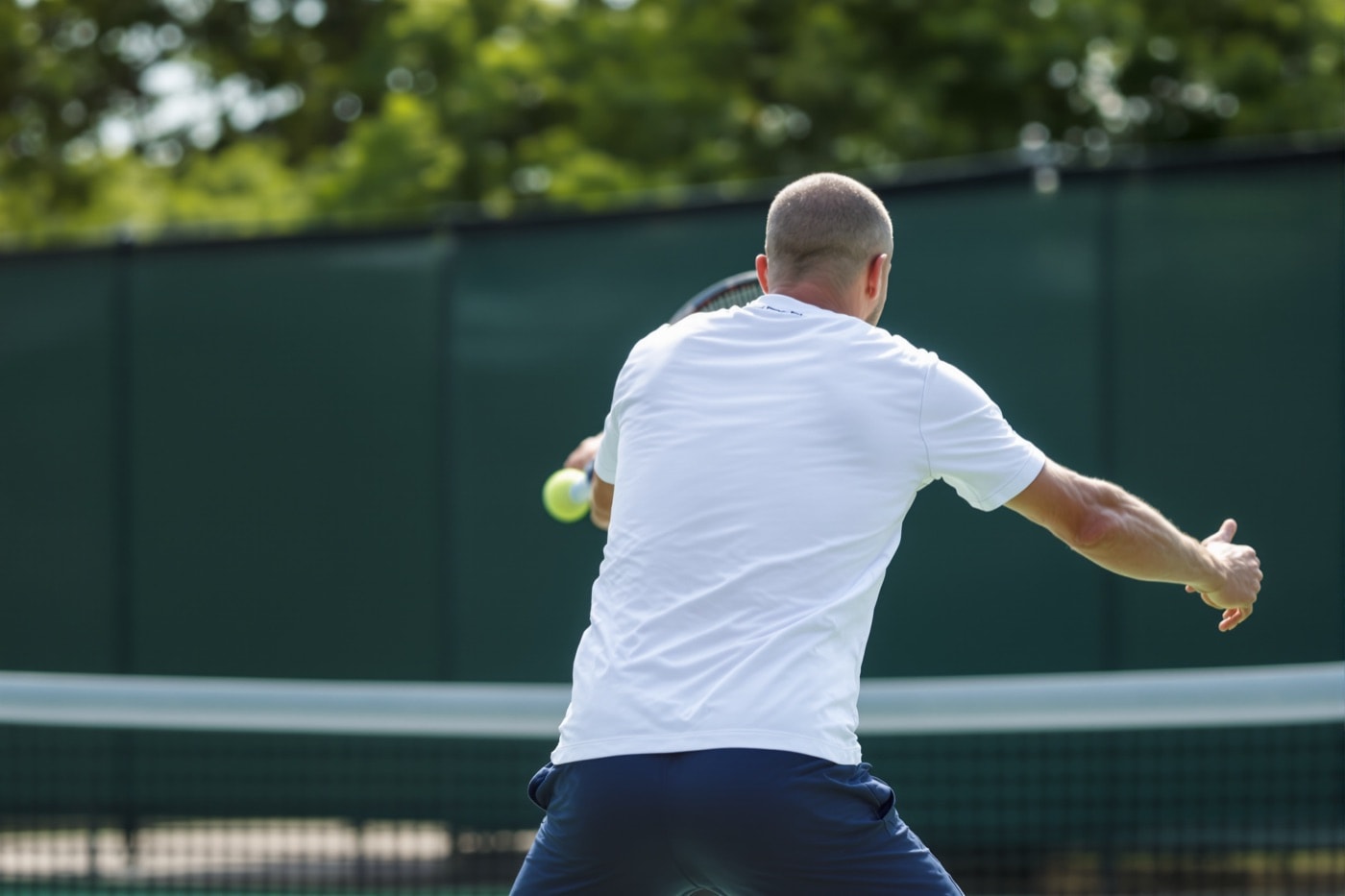
For most club players the backhand is the side that gets attacked, and it usually deserves it. The stroke itself is not intrinsically harder than the forehand; what makes it fragile is that it is hit far less often, so the same number of playing hours produces far fewer repetitions. The fix is partly technical and mostly about where you choose to stand and how much you are willing to hit it.
One hand or two?
This is the only genuine fork in tennis technique, and the honest answer is that both work.
The two-handed backhand
Advantages. More stable against pace, because two arms resist a heavy ball better than one. Easier to learn and easier to keep grooved. Superior on the return of a fast serve and on high-bouncing balls, where the second hand keeps the racket head up. Disguise is better — an opponent cannot easily read direction from the preparation.
Costs. Less reach on a wide ball, so movement has to be better. Slightly harder to transition to a slice and to a volley, because both require releasing the second hand and changing grip.
The one-handed backhand
Advantages. Greater reach, which buys time on the wide ball. Natural continuity with the slice and the volley, since the grip is closer. Often a better feel for touch shots and drop shots.
Costs. Genuinely more difficult against high, heavy topspin — the contact point sits above the shoulder and the single arm has poor leverage there. Requires earlier preparation and cleaner footwork, and it punishes late contact more severely than any other groundstroke.
If you are choosing: a two-hander is the lower-risk option for an adult player with limited practice time, and a one-hander is a reasonable choice if you already have a comfortable slice, play mostly on lower-bouncing surfaces, and enjoy coming forward.
Building the two-handed backhand
Think of it as a left-handed forehand for a right-handed player: the non-dominant hand does most of the driving, and the dominant hand mostly steers. Players who lead with the dominant arm produce a stiff, blocked shot with no acceleration.
- Grip. Dominant hand continental or slightly eastern-backhand; non-dominant hand in an eastern forehand grip above it.
- Turn. Shoulders rotate as a unit, further than on the forehand — you should be able to see your back shoulder pointing at the net.
- Drop and drive. Racket head falls below the ball; the non-dominant arm pulls the handle forward and up.
- Contact. In front of the front hip, closer to the body than a forehand.
- Finish. Both hands over the opposite shoulder, hips having rotated to face the target.
Building the one-handed backhand
The one-hander lives or dies on two things: the shoulder turn and the timing of the contact point.
- Grip. Eastern backhand — knuckle on the top bevel — or a more extreme version for heavier spin.
- Turn. Full, with the non-dominant hand holding the racket throat and the back to the opponent more than feels comfortable. The non-dominant hand stays back as the swing starts, which prevents the shoulders opening early.
- Contact. Notably further in front than a two-hander, and with a straight arm. A one-hander contacted level with the body has no leverage at all and will float.
- Finish. Hitting arm extended towards the target, non-dominant arm swept back behind — that trailing arm is the counterbalance that keeps the shoulders closed.
The slice
The slice is not the poor relation. It is a different shot with a different job, and it is the most underused tool in club tennis.
A continental grip, a high-to-low swing path and an open face impart backspin, which makes the ball stay low after the bounce, travel slower through the air and skid rather than sit up. It is the correct choice when you are pulled wide and need time, when the ball is below knee height, when you want to change the rhythm of a rally against a player who likes pace, and as an approach shot — a low skidding ball is very hard to pass off.
Slice becomes far more effective on fast, low surfaces and comparatively less so on high-bouncing clay, where the ball has more time to sit up.
Why backhands break down under pressure
Three reasons, in order of frequency.
- You are running around it. Every backhand avoided is a repetition not banked, and the avoidance is legible to an opponent, who will then serve to it every time on the important points.
- Preparation starts too late. The backhand needs an earlier turn than the forehand — particularly the one-hander. Under pressure, preparation is the first thing to slip.
- Contact drifts backwards. Nervous players wait on the ball. Waiting is fatal on this side.
The practice that fixes all three is the same: play sets in which you are not permitted to run around the backhand. You will lose the first few. The LTA's improvement resources are a reasonable place to find structured backhand progressions to work alongside it, and the footwork page covers the preparation timing that underpins the whole stroke.