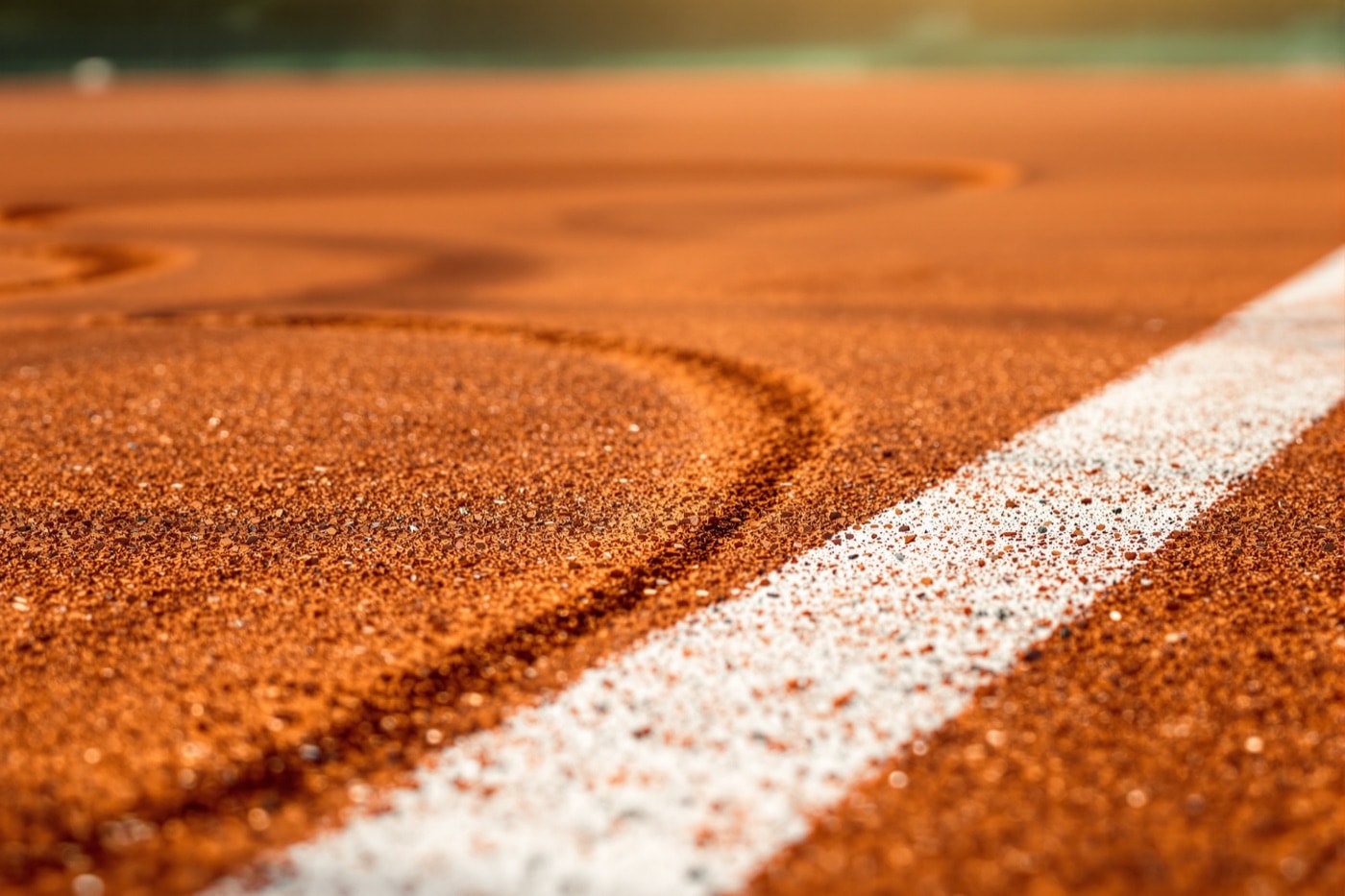
A tennis court is not a neutral stage. The surface decides how fast the ball leaves the bounce, how high it sits up, how much of the spin survives the contact with the ground, and — just as importantly — whether you can slide into a shot or must stop dead. Two players of identical standard can produce completely different matches on two different surfaces, and the player who understands why will adjust faster.
The ITF classifies court surfaces by pace, running from slow through medium to fast, and the classification is measured rather than asserted. The categories below are the practical ones.
Read the court before naming it
The surface label is only a starting point. Two hard courts can differ because of their coating, wear and cleanliness; two clay courts can differ because one has more loose material or retained moisture. Before calling a court “fast” or “slow”, separate three observations: speed after the bounce, bounce height, and grip during braking.
The warm-up gives enough evidence if it is used deliberately. Send several similar balls through the middle and watch where the second bounce occurs. Trade cross-court topspin and slice to compare their trajectories, then make a few controlled changes of direction below full speed. A predictable bounce may still demand earlier braking, while a low-skidding court may allow normal preparation. “Fast” does not describe every part of the problem.
Recheck after conditions change. Moisture, fresh brushing, dust, worn patches and balls collecting grit can alter bounce or footing during a session. Add net clearance when the bounce becomes uncertain, shorten the backswing when it stays low, and begin decelerating sooner when grip increases. Testing the surface this way prevents a tactical mistake from being misdiagnosed as poor timing.
Clay
Clay is a loose granular layer over a compacted base. Because the top layer moves, it takes energy out of the ball horizontally and converts a good deal of forward speed into upward bounce. The result is the slowest and highest-bouncing common surface, and the one on which topspin is most rewarded: a heavy ball that would sit at shoulder height on a hard court can climb well above it here.
Two consequences follow. First, outright winners are much harder to hit, so points are longer and the reward shifts from power to construction — moving an opponent side to side and forward and back until the court opens. Second, you can slide, which changes movement entirely: rather than decelerating over several steps, you arrive and let the surface absorb the deceleration, which lets you take a fuller swing on a ball you would otherwise have to scramble at.
Sliding is a learned skill and the most common way to get it wrong is to attempt it on a surface with insufficient loose material, where the foot grips instead of sliding. Practise the movement on a well-maintained court before you rely on it in a match.
What to change on clay
- Add net clearance and spin; a flatter ball that works elsewhere will find the net or sit up invitingly.
- Expect to hit two or three more balls in every rally, and plan for it in your conditioning.
- Move your baseline position back a step against heavy topspin, and be willing to step in aggressively on the short ball, which is where the point is actually won.
Hard courts
Acrylic-over-asphalt or concrete, hard courts are the most common surface worldwide and the most variable — the pace depends almost entirely on how much sand is in the top coating. A gritty, heavily textured hard court can play nearly as slowly as clay; a smooth one plays quickly and low. The bounce is consistent and predictable, which is why hard courts are the fairest test of technique and the least forgiving of a badly timed swing.
Footing is the concern. There is no slide, so every direction change is absorbed by your joints. This is the surface with the strongest link to overuse complaints, and it is the reason the conditioning page puts so much emphasis on deceleration strength rather than pure speed.
What to change on hard courts
- Trust the bounce and take the ball earlier; the reward for stepping inside the baseline is higher here than on clay.
- Cushioned shoes with a durable outsole matter more than on any other surface.
- Recovery footwork must be genuine — you cannot slide out of a poor position, so the split-step timing described on the movement page becomes the limiting factor.
Grass
Grass is fast and low, and — critically — inconsistent. The ball skids off the surface with much of its speed intact and comparatively little of its spin, so slice stays low and a heavy topspin ball loses a good deal of its bite. Bounces vary with wear, moisture and the condition of the root layer, which places a premium on early preparation: if you wait to see the bounce, you are late.
Because rallies are short and the first strike dominates, grass rewards the serve, the return and the ability to close the net. It punishes players who need three or four balls to construct a point.
What to change on grass
- Bend lower and prepare earlier; the ball will not come up to meet you.
- Slice becomes a genuine weapon rather than a defensive shot.
- Shorten the backswing — there is less time, and a compact swing survives a bad bounce.
Cushioned synthetic and carpet
Artificial grass with a sand infill, needle-punch carpet and modular tile systems each behave differently but share one trait: the ball tends to stay low and skid, and the surface is kinder to the legs than concrete. Sand-filled artificial grass allows a limited slide, which some players find the most comfortable compromise available. Indoor carpet is generally fast and very consistent, which suits flat hitters and big servers.
Adjusting quickly when you switch
The practical routine is short. In your first ten minutes on an unfamiliar surface, hit six or eight cross-court balls and pay attention to exactly two things: where the ball is when it reaches its peak, and how many steps it takes you to stop. The first tells you where to stand and how much spin to use. The second tells you how early you need to start moving. Almost every other adjustment follows from those two observations, and most players who "can't play on" a given surface have simply never made them deliberately.