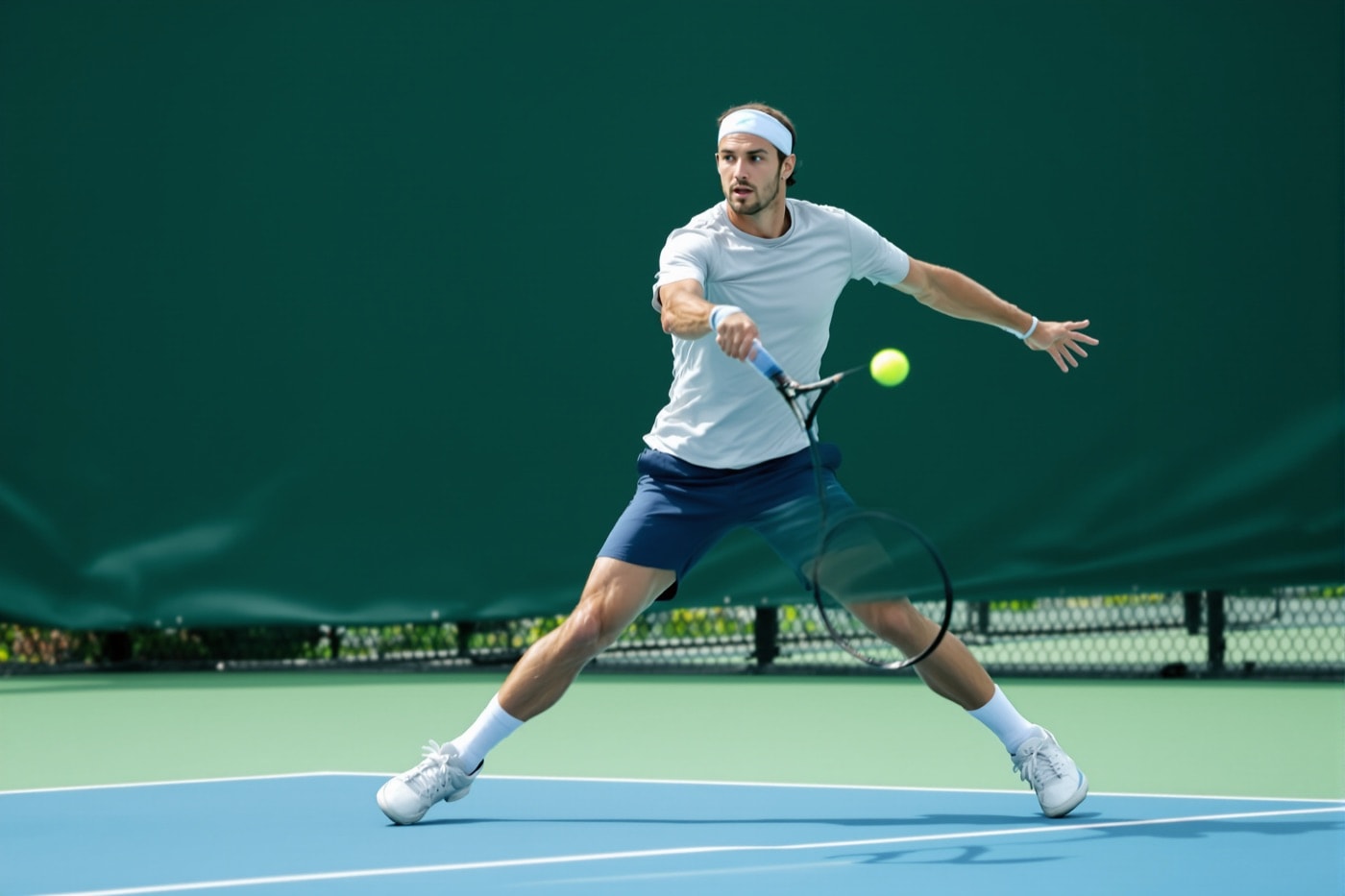
The forehand is the shot most players hit most often and the shot most players practise least deliberately. It is also the stroke where the gap between what is taught and what good players do is widest, because a great deal of forehand instruction still describes a stroke shape that stopped being standard decades ago.
The modern forehand is built around one idea: the racket travels from low to high through a ball struck out in front, with the face closing through contact by rotation rather than by wrist flick. Everything below is downstream of that.
Grips, and what each one commits you to
Grip is described by which bevel of the handle the base knuckle of the index finger sits on.
- Continental. Effectively unusable for a modern forehand — the face is too open and the natural contact point is too far back. It survives for serves, volleys and slice.
- Eastern. Palm behind the handle. Comfortable contact from knee to chest height, natural for a flatter, driving ball, and the easiest grip from which to hit through a low ball. Excellent on grass and fast, low courts.
- Semi-western. The modern default. Contact point further forward and higher, a naturally more closed face and a steeper swing path, producing far more topspin than eastern for the same effort. Handles a shoulder-height ball comfortably. Slightly awkward on a very low ball.
- Full western. Maximum topspin and a very high comfortable contact point. Superb on high-bouncing clay, genuinely difficult on low skidding balls, and it makes the transition to a continental volley grip slow.
There is no best grip. There is a grip that matches the height of the ball you most often face — which is decided largely by the surface you play on — and the strokes that grip commits you to.
The sequence
The unit turn
The first movement after the split-step is a turn of the shoulders and hips together, with the non-dominant hand staying on or near the racket throat. This is one motion, not two, and it happens before any conscious backswing. If you take the racket back with the arm while the torso stays square, you have removed the body's contribution and the arm must supply all the power — the most common cause of both weak forehands and sore shoulders.
The loop and the drop
From the turn, the racket head rises and then drops below the intended contact height. That drop is not decoration: it is what creates the low-to-high path that produces topspin. Players who take the racket straight back on a flat plane have no drop, no upward path, and therefore no spin — after which they must hit gently to keep the ball in.
Contact
Contact happens in front of the front hip, with the arm extended but not locked. Almost every mishit forehand at club level is contacted too late and too close to the body. The corrective feel most players respond to is "catch the ball earlier than feels natural" — because late contact feels normal once it has become habitual.
The finish
Where the racket finishes tells you what the swing path was. Over the opposite shoulder is a conventional topspin drive. Higher, finishing near the same-side ear after a sharply upward path, is the heavy-spin "windshield wiper" finish used to bring a fast ball down inside the baseline. A finish out towards the target with little upward travel is a flat drive: more pace, far less margin.
Do not chase a finish for its own sake. The finish is evidence of the swing, not the cause of it.
Stances
The open stance, with both feet roughly parallel to the baseline, allows you to hit while still moving outwards and to recover quickly using the outside leg — it is the default for a wide ball and the reason modern players cover so much court. The neutral or closed stance, stepping across towards the net, transfers weight forward more effectively and suits a ball you are moving into. Good players use both and choose by whether they are moving out or in, not by preference.
The four faults that cause most errors
- Late contact. Fixed by earlier preparation and better spacing — a footwork problem far more often than a swing problem.
- Arming the ball. No unit turn, so the arm does everything. Fixed by making the shoulder turn the first movement, before the backswing.
- No racket drop. A flat backswing produces no topspin. Fixed by letting the racket head fall below the ball before starting forward.
- Crowding the ball. Standing too close, so the arm cannot extend. Fixed with small adjusting steps in the last metre rather than one large one.
A practice that works
Rally cross-court only, aiming to land every ball beyond the service line, and count consecutive balls. Cross-court is the longest dimension of the court and the safest pattern; depth is what actually pushes an opponent back. Twenty consecutive deep cross-court forehands is a harder and more useful test than any number of winners. The USTA's instruction library has structured drill progressions if you want a session plan rather than a single exercise.