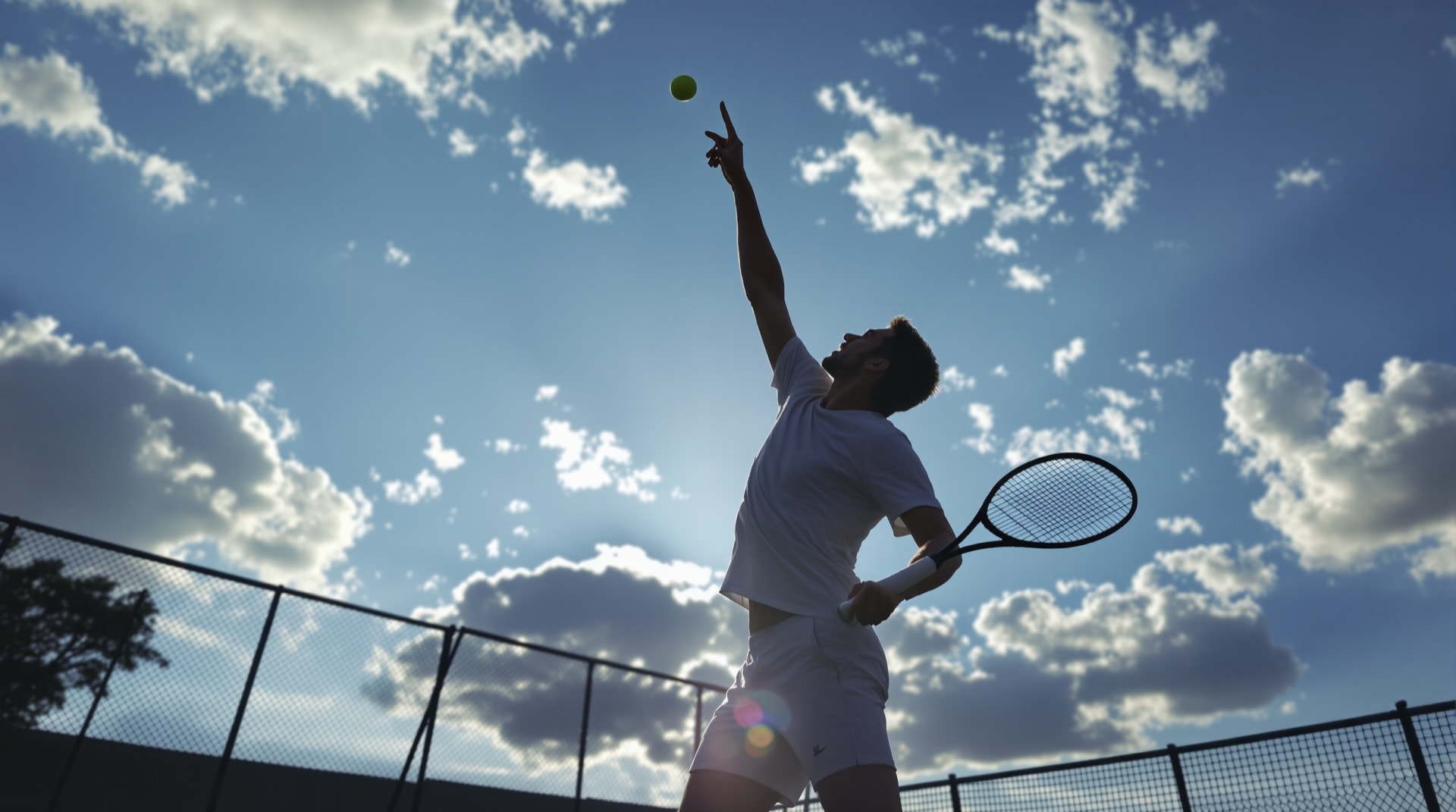
The serve is the only shot in tennis you control completely. Nobody is hitting anything at you; the ball is stationary in your hand; you choose the moment. That makes it simultaneously the most improvable shot in the game and the one most commonly left unimproved, because it is the only shot you can practise entirely alone and therefore the only one people never practise.
It is also the shot with the highest ceiling for a club player. A second serve that cannot be attacked changes every service game you play.
The grip is non-negotiable
The serve is hit with a continental grip — the base knuckle of the index finger on the top-left bevel for a right-handed player, the same grip you would use to hammer a nail with the racket edge. Anything more towards a forehand grip forces the racket face to point at the target throughout, which physically prevents the forearm rotation that produces both spin and racket-head speed.
This is the one place where "whatever feels comfortable" is bad advice. A forehand-grip serve will feel far more comfortable and will cap your serve permanently at a slow, flat, spinless push. If you change one thing about your serve, change this, and accept two or three weeks of it feeling awful.
The toss
More serves are ruined by the toss than by the swing. It should be released from a straight, rising arm at roughly shoulder height rather than flicked from the wrist, and it should reach a peak slightly above the racket's maximum reach so the ball is falling gently at contact.
Placement, for a right-handed player:
- Flat serve: slightly in front and marginally to the right, so you can hit up and through it at full extension.
- Slice serve: further to the right, so the racket can travel around the outside of the ball.
- Kick serve: further left and more over the head, allowing an upward, brushing path from low-left to high-right.
The test is boring and decisive: toss twenty balls without swinging and let them drop. If they do not land within a small area you could cover with a towel, the toss is your limiting factor, and no amount of work on the swing will get past it.
The trophy position
At the top of the toss the body should reach a recognisable checkpoint: tossing arm extended upwards and still pointing at the ball, hitting elbow up and roughly level with the shoulder, racket head above the elbow, knees bent, front hip pushed slightly towards the court, shoulders tilted so the back shoulder is lower than the front. From there everything is a chain.
The chain: legs, hips, shoulders, arm, hand
Power comes from the ground up, and in that order. Leg drive extends the knees and hips upward. The hips rotate, then the shoulders, then the arm swings up and the racket drops behind the back — the racket drop, the deepest position of the swing and the single best predictor of racket-head speed. Only then does the arm extend upwards to meet the ball.
Players who "muscle" the serve typically skip the leg drive and the racket drop and swing with the arm alone, producing a slow serve and, over time, a sore shoulder.
Pronation
As the arm extends, the forearm rotates so the palm turns outwards and the racket face squares to the ball and then continues past it. This is pronation, and it is the mechanism that both accelerates the racket head and lets the same swing produce different spins.
It is not something to do consciously — attempting to "add pronation" as a deliberate action produces a wristy, mistimed serve. It is what naturally happens when a loose arm swings fast with a continental grip. If it is missing, the grip is nearly always why.
The three serves
- Flat. Racket travels straight through the back of the ball at full extension. Fastest, lowest margin, hardest to make consistently. A first-serve shot, and best directed down the middle where the net is lowest.
- Slice. Racket brushes around the outside of the ball, producing sidespin. The ball curves and stays low. Excellent for pulling a right-handed opponent wide in the deuce court, and reliable enough to use on a second serve.
- Kick. Racket brushes from low-left to high-right, producing topspin and sidespin. The ball leaves the racket at a steep angle, clears the net with a lot of margin, drops sharply and then bounces high and away. This is the second serve worth building: it is the only one that is both safe and awkward to attack.
Practising alone
A basket of balls and twenty minutes twice a week will change your serve within a season, and almost nothing else in tennis has that return. Structure it: ten minutes on toss and trophy position without hitting, then serve to targets rather than "in" — a cone or a ball can in each corner of the box. Track first-serve percentage across a basket, because a 70% first serve at moderate pace wins more games than a 45% first serve that is faster.
Serving is also the most shoulder-intensive activity in the sport, so the rotator-cuff and scapular work described on the conditioning page is not optional if you intend to serve a lot. The USTA instruction library covers serve progressions in more detail, and the service rules themselves — foot faults, lets, the order of service — are set out in the ITF Rules of Tennis.