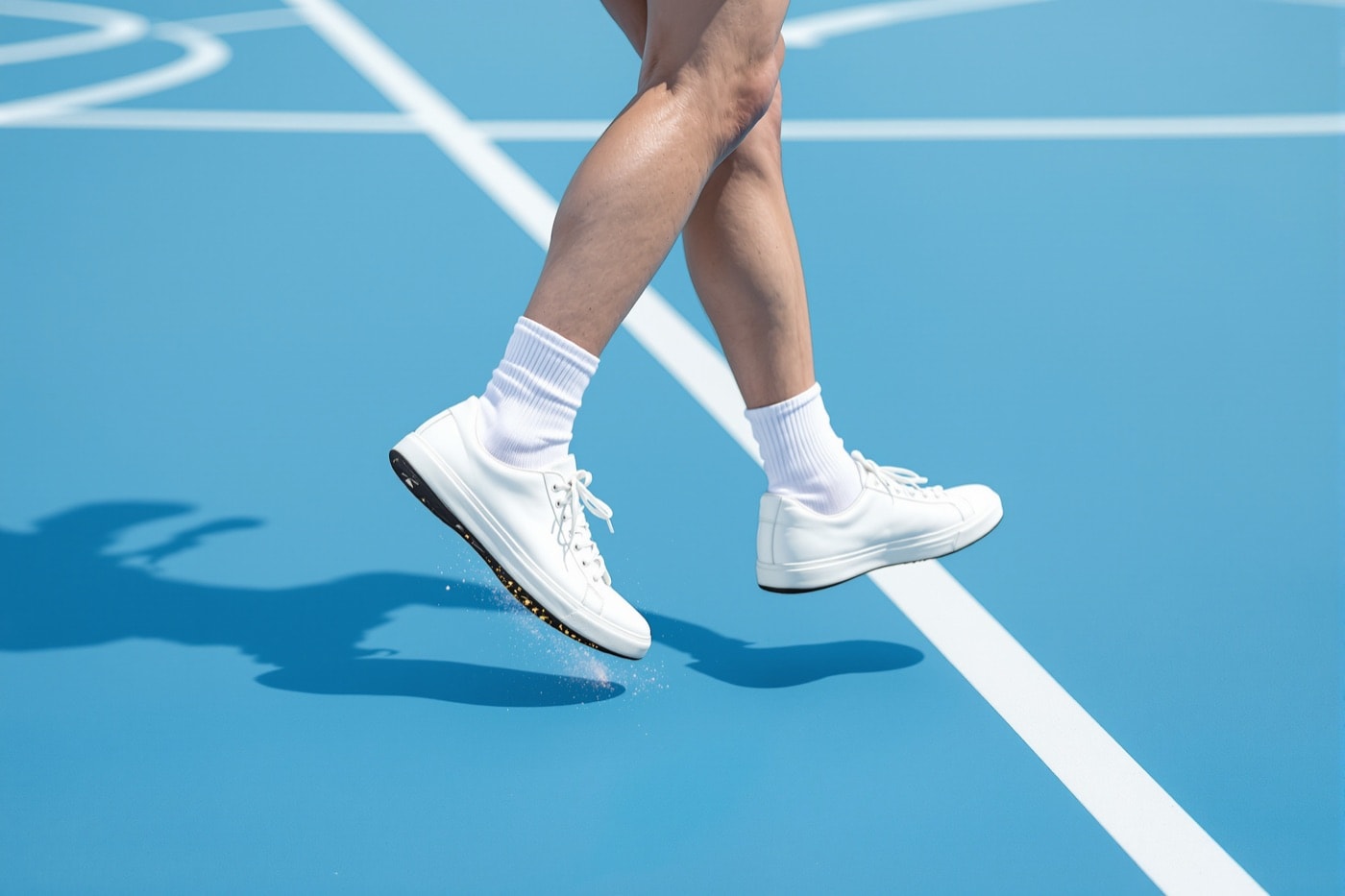
If you filmed a club match and a professional match and removed everything above the waist, the difference would still be obvious — and it would be more obvious, not less. The strokes at club level are often reasonable. What separates standards is arriving at the ball early, at the right distance from it, and in balance.
This is why the single most productive thing many players can do is stop working on their swing.
The split-step
A small hop, landing on the balls of both feet, timed so that you land just as your opponent strikes the ball. It is not a pause and it is not decorative. Landing loads the legs elastically, so the first movement in any direction is faster, and it forces the eyes and body to be still at the one moment when information about the incoming ball becomes available.
The timing is the whole trick, and the common error is splitting too late — after the ball has been hit — which converts a preparation into an interruption. Split as their racket comes forward, land as it makes contact.
Split-step on every shot, including the return of serve, including when you think you know where the ball is going.
The first step
From the split, the first movement should be a small pivot or drop-step of the foot nearest the direction of travel, opening the hips towards the ball. Players who instead take a large crossover step first are committing before they have finished reading the ball, and cannot correct if it is disguised.
For balls within a couple of metres, side-shuffle steps keep you square and ready. For anything wider, a crossover running step covers ground far more efficiently — shuffling to a wide ball is the classic way to arrive late and stretched.
Adjusting steps: the part nobody practises
The last three steps before contact are where good spacing is created, and they should be small. Amateur movement typically looks like three large steps and a lunge; competent movement looks like two large steps and four small ones.
Small final steps let you correct distance continuously as the ball's flight resolves. Large final steps commit you to a spacing decision made too early, which is why so many club forehands are hit either jammed against the body or at full stretch. Neither is a swing fault. Both are step-size faults.
The drill: rally cross-court and count your steps out loud in the last metre. If the number is under three, you are not adjusting.
Read first, then travel
Fast movement begins with early information, not with running harder. Watch the opponent through the final part of the swing: contact height, racket-face direction and balance together narrow the likely reply before the ball crosses the net. This is not an invitation to guess. It is a way to organise attention so that the split-step lands with useful information already arriving.
Practise the read by calling “short”, “deep”, “left” or “right” before the ball crosses the net during a cooperative rally. Wrong calls expose whether you are watching contact or merely following the ball after it has left. Keep the first movement compact enough to correct. An early read earns an early start; it does not justify full commitment before the flight is clear.
Depth is usually the first decision. A shorter ball asks for movement through the court and forward balance. A deep ball asks for space behind the bounce, created with a drop-step or quick retreat rather than by leaning backwards at contact. Once depth is read, lateral positioning becomes simpler. This avoids sprinting sideways towards a ball that is actually driving the player backwards.
Recovery
Recovery begins before the ball you just hit has landed. Two principles govern it.
Recover along the bisector, not to the middle. The correct recovery position is not the centre mark; it is the point that bisects the angle of your opponent's possible replies. If you have hit a wide cross-court ball, that bisector sits noticeably towards the side you hit to, because the sharpest angle available to them is back in that direction. Recovering all the way to the centre after a good wide ball hands back the advantage you just created.
Recovery depth depends on what you hit. A deep, heavy ball buys time — recover to or behind the baseline and set up. A short ball you were forced into means the reply will arrive quickly and you should be moving forward, not backward, because the counter is likely to be an angle you must cut off.
On clay the slide does part of the recovery for you; on hard courts every direction change is paid for by the joints, which is why the deceleration strength work on the conditioning page matters.
Movement patterns worth drilling
- Side to side, deep. Alternating deep cross-court and down-the-line balls fed to the corners. Goal: split-step, arrive, recover to the bisector every ball. Sets of 60–90 seconds.
- Up and back. A deep ball then a short ball, repeatedly. This is the pattern club players cover worst, and it is the one good opponents exploit first.
- The spider run. From the centre mark, touch each of the five court corners and return. It measures change-of-direction fitness honestly and can be timed and tracked over a season.
- Shadow footwork with no ball. Five minutes of split-step, first step, adjusting steps and recovery against an imaginary feed. Unglamorous, and it transfers.
The shoes
Tennis-specific shoes are the piece of equipment with the clearest injury argument behind them. Running shoes are built for straight-line motion with soft, high midsoles that roll under lateral load; tennis shoes are built with a wide, stable base, lateral support and an outsole matched to a surface. Playing lateral sport in running shoes is the most common avoidable ankle risk in club tennis.
Replace them when the outsole wears through at the toe or the outside edge, not when they look tired. For court-appropriate outsole patterns and surface classifications, the ITF's court surface information is the reference.