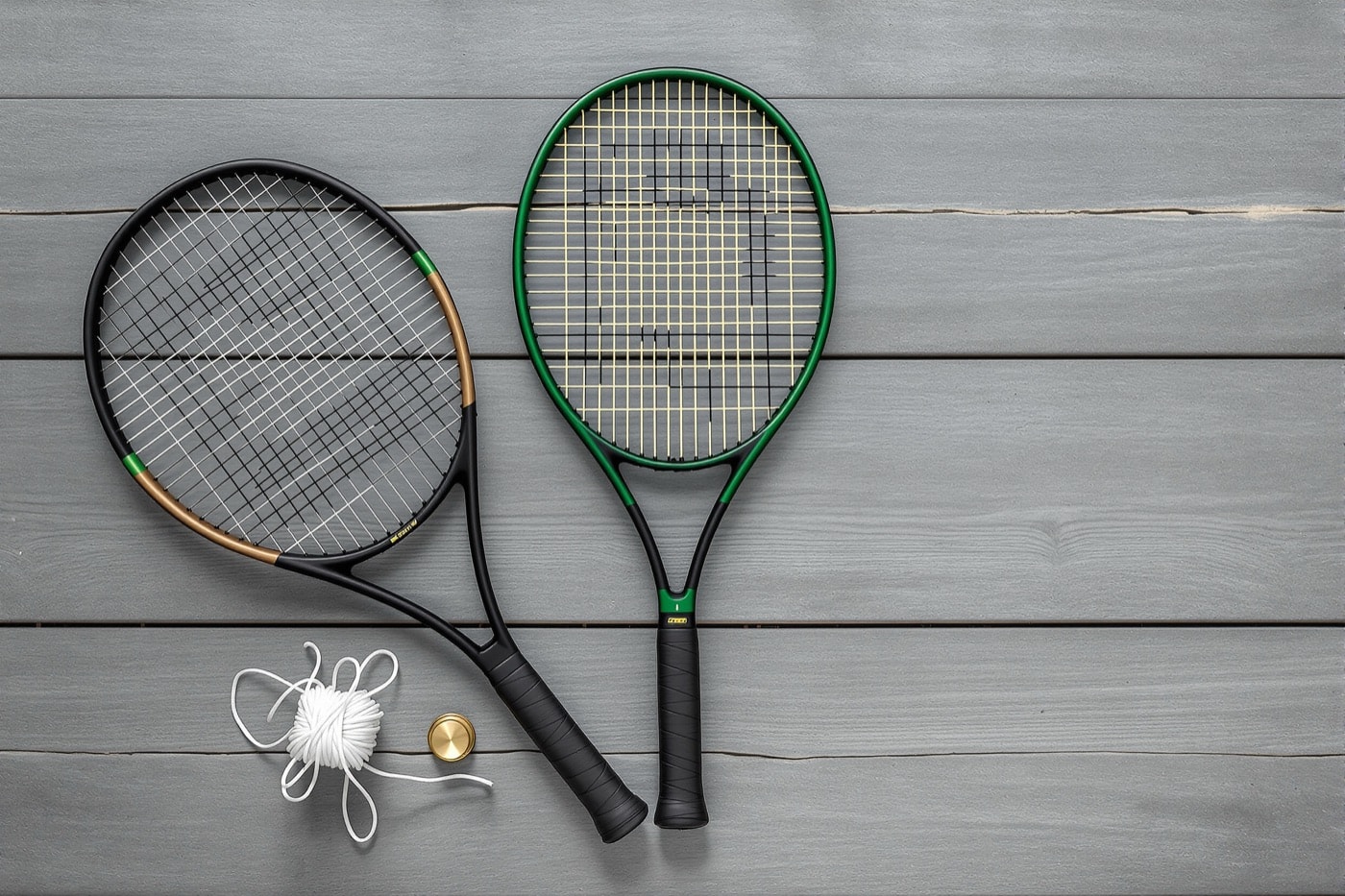
Racket marketing is built on adjectives. The specification sheet is built on numbers, and the numbers are the part that predicts how a frame will feel. There are four of them, plus two secondary ones, and once you can read them you can shortlist sensibly without hitting with forty frames.
The single organising principle: a racket should complement the swing you already have, not the swing you wish you had. If your swing is short and firm, you need the frame to supply the power. If your swing is long and fast, you need the frame to supply control, because you are already supplying plenty of power.
1. Head size
Measured in square inches, typically 95 to 110 for adult frames. A larger head gives a bigger sweet spot, more forgiveness on off-centre hits and — because the strings are longer and deflect more — more power and more spin potential. A smaller head gives a more precise, connected feel and more control at high swing speeds.
- 95–98 sq in: for players with fast, full swings who generate their own pace and want feedback.
- 98–102 sq in: the modern default. Enough forgiveness for club play, enough precision for competitive play.
- 103–110 sq in: genuinely helpful for players with compact swings, and for anybody whose contact point is inconsistent.
The frequent mistake is treating a large head as a beginner's compromise. It is not. It is a legitimate choice for a player whose swing does not produce its own power.
2. Static weight
The weight of the frame, usually quoted unstrung, from roughly 270 g to 330 g. Heavier frames are more stable against a fast incoming ball, transmit less shock into the arm and produce more depth for the same swing. Lighter frames are easier to accelerate and easier to get into position late.
The trade-off is real and it is physical, not psychological: a light frame gets pushed around by a heavy ball, and the player compensates by swinging harder, which is how a great many arm complaints begin. If you are choosing between two frames and can comfortably manage the heavier one for a full match, the heavier one is usually the better long-term choice.
3. Balance
Where the mass sits along the length, quoted as the distance from the butt cap to the balance point, or as "points head-light / head-heavy" relative to the midpoint.
- Head-light frames feel quick and manoeuvrable. They suit players who volley, who need fast racket-head changes, and who use a heavier overall weight.
- Head-heavy frames put mass out where the ball is struck, producing more plough-through from a slower swing. They suit light frames and compact swings.
Two rackets of identical static weight and different balance feel like completely different objects, which is why weight alone tells you very little.
4. Swingweight
Swingweight combines weight and balance into a single number describing how heavy the racket feels while swinging, typically 280 to 340. It is the most predictive single specification and the one least often printed on the frame.
A high swingweight gives stability and depth but demands earlier preparation — arrive late with a high-swingweight frame and you will be late for the rest of the point. A low swingweight is forgiving of late preparation but gets deflected by pace. If you are consistently late on the return of serve, dropping swingweight will do more for you than any other change.
The two secondary specifications
Stiffness (RA)
A stiffer frame (roughly RA 68 and above) deforms less, returns more energy and gives more power with a harsher feel. A more flexible frame (RA 62 and below) absorbs more, feels more comfortable and gives more control. Players with any history of elbow or wrist trouble should be cautious about combining a stiff frame with a stiff string — the two effects compound, and the combination is the single harshest setup available.
String pattern
An open pattern (16×19) lets the main strings move and snap back, producing more spin and more power, at the cost of string life. A dense pattern (18×20) gives a flatter, more controlled, more predictable response and lasts longer. Open patterns suit brushing, upward swing paths; dense patterns suit flatter drives.
Grip size
Too small a grip encourages over-gripping and is associated with elbow strain; too large restricts wrist action on the serve. The traditional check is to hold the racket in an eastern forehand grip and see whether the index finger of the other hand fits in the gap between fingertips and palm. It is a rough guide, and it is easier to build a grip up with an overgrip than to shave one down, so err small if you are between sizes.
A workable process
- Write down the specifications of the racket you use now — all four numbers if you can find them.
- Decide which single quality you are missing: depth, control, manoeuvrability or comfort.
- Change one specification in that direction and keep the others close.
- Hit with the candidate for at least two sessions before judging. Almost every frame feels wrong for twenty minutes.
Before spending anything on a new frame, change your strings and try one tension step in each direction. Strings alter the playing characteristics of a racket more than most players expect, they cost a fraction of a frame, and the string page explains how to run that test properly. The ITF's technical department publishes the equipment rules if you want to confirm that a frame or a stringing pattern is legal for competition.